Basic Life Support (BLS): Essential Skills for Emergency Response
What is basic life support?
Basic life support (BLS) refers to a set of essential emergency response skills used to support or sustain life until advanced medical care is available. While emergency medical personnel are trained to deliver BLS using specialized equipment, many core BLS skills can be learned and used by the public through proper training.
In Canada, BLS knowledge is especially important in workplaces, schools, recreational settings, and public spaces—where emergencies such as cardiac arrest, choking, or sudden illness can happen without warning.
Why basic life support matters in Canadian workplaces and communities
 Medical emergencies do not only happen in hospitals. They often occur:
-
At work
-
At home
-
In public places
-
During sports or recreation
Workplace first aid programs and BLS training help ensure that someone nearby can recognize an emergency, call for help, and provide early care, which can significantly improve outcomes while waiting for emergency responders.
Scenario: Early action makes a difference
During a staff meeting, a coworker suddenly collapsed and became unresponsive. Another employee trained in basic life support recognized the emergency, asked someone to call 911, and began CPR while an automated external defibrillator (AED) was retrieved. Emergency services arrived shortly after and took over care. The early response helped maintain circulation during a critical time.
The chain of survival
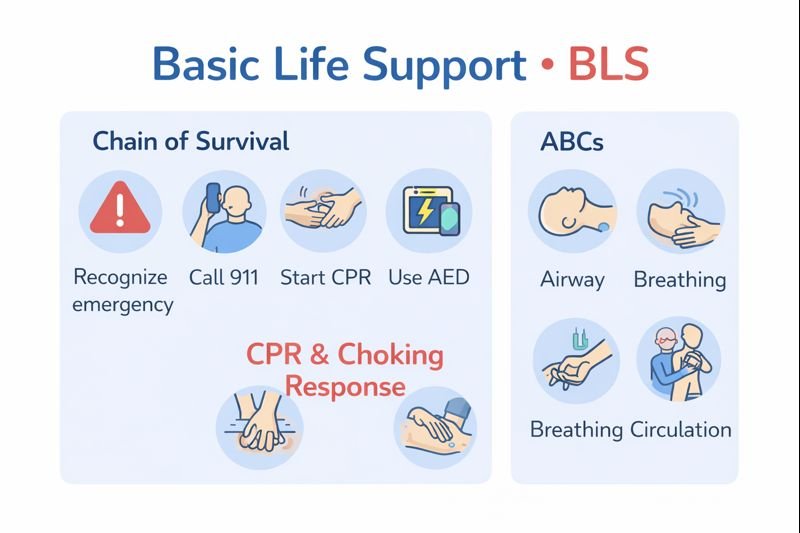
The chain of survival is the foundation of basic life support. It describes the critical steps that improve survival during life-threatening emergencies, especially cardiac arrest.
The key links include:
-
Early recognition of an emergency
-
Calling for emergency assistance
-
Early CPR to support circulation and breathing
-
Early defibrillation using an AED when available
Each step supports the next. Delays at any point can reduce the chance of survival, which is why early action by bystanders is so important.
ABCs of basic life support
Basic life support focuses on managing the ABCs:
Airway
Recognizing when the airway is blocked or not open enough to allow normal breathing, and taking steps to help keep it clear.
Breathing
Determining whether someone is breathing normally and providing rescue breathing when trained and appropriate.
Circulation
Checking for signs of circulation, managing severe bleeding, and supporting blood flow through CPR when needed.
Together, these steps help maintain oxygen delivery to vital organs until advanced care arrives.
Cardiopulmonary resuscitation (CPR)
CPR is one of the most well-known basic life support skills and can be performed by trained members of the public as well as professionals.
CPR is used when a person:
-
Is unresponsive
-
Is not breathing normally
-
Shows no signs of circulation
It involves:
-
Chest compressions to help circulate blood
-
Rescue breathing (when trained) to provide oxygen
Early CPR can significantly increase the chance of survival during cardiac arrest, particularly when combined with rapid defibrillation.
Choking response
Choking occurs when a foreign object, such as food, blocks the airway and interferes with breathing.
Basic life support training includes recognizing signs of choking and responding appropriately. One commonly taught technique is the abdominal thrust maneuver, which uses controlled upward thrusts to help dislodge an airway obstruction and restore airflow.
Quick recognition and action are essential, as severe airway obstruction can quickly become life-threatening.
Prevention and workplace considerations
Employers and organizations can support basic life support readiness by:
-
Ensuring AEDs are accessible and clearly marked
-
Promoting awareness of emergency response plans
-
Encouraging staff to act quickly and confidently in emergencies
Frequently Asked Questions
Is basic life support only for healthcare workers?
No. Many BLS skills are designed for trained members of the public and are commonly taught in workplace first aid courses.
Why is early CPR so important?
CPR helps circulate oxygenated blood to the brain and heart until normal circulation can be restored.
What is the role of an AED in basic life support?
An AED delivers a controlled electrical shock that may help restore a normal heart rhythm during cardiac arrest.
Can choking happen silently?
Yes. Severe choking may occur without coughing or noise, which is why recognizing signs of distress is important.
Does basic life support replace professional medical care?
No. BLS provides early support until emergency medical services arrive and take over care.
Educational note
This article is intended for general first aid and workplace education. Formal training is required to learn and practise basic life support skills safely and effectively.